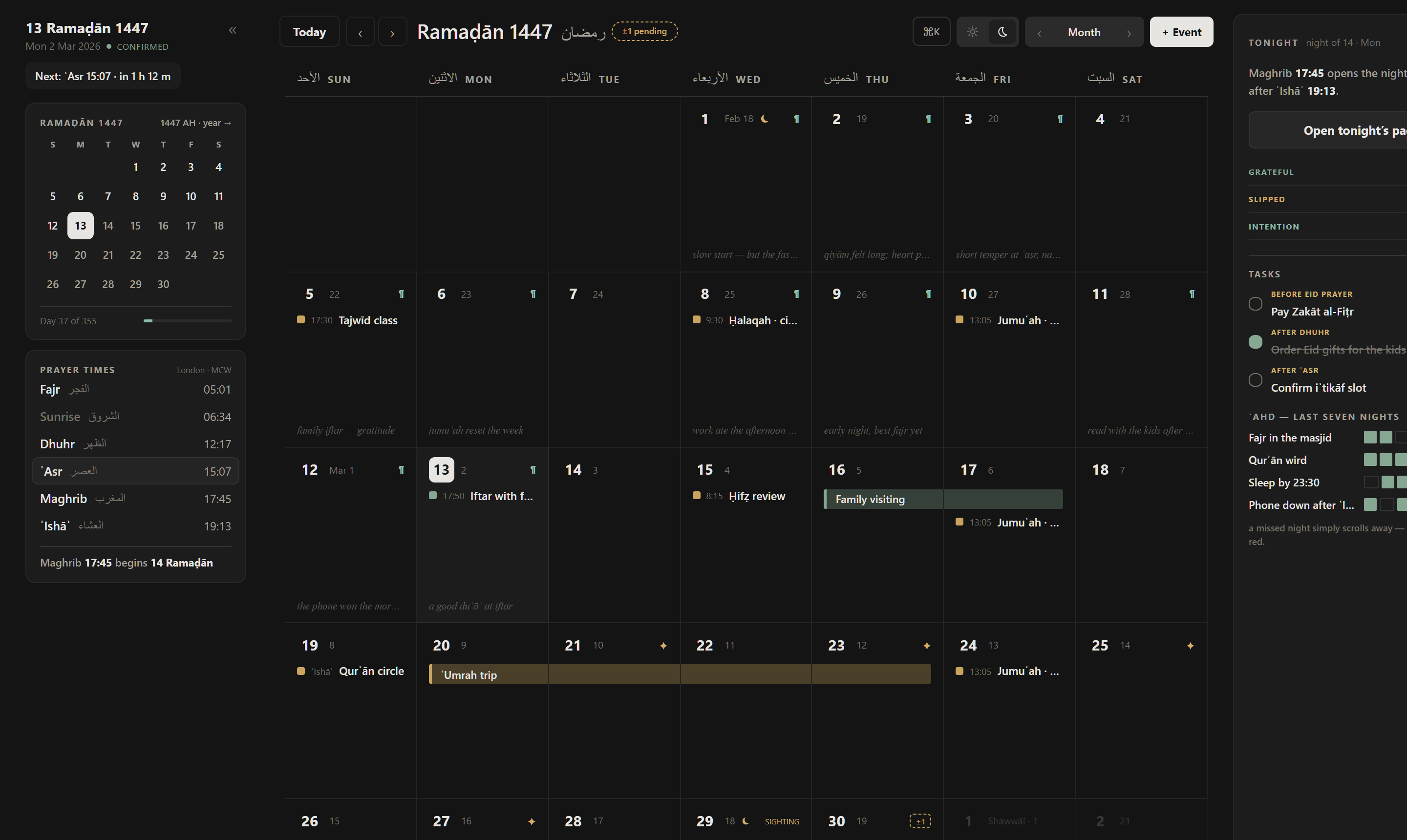
Know the night your zakat year turns, when the white days fall, when Ramaḍān actually begins — without counting any of it out yourself. Schedules that respect ṣalāh, dates that admit what isn’t certain yet.
Twelve months, each with its own weight — the sacred four, the fast, the pilgrimage. The Gregorian year is twelve boxes; this one has a shape.
The year opens on a sacred month — ʿĀshūrāʾ falls on its tenth.
Q. 9:36 · Muslim 1162Every month walks the whole year — Ramaḍān's fasts, the days of Ḥajj, all of it, shared by every hemisphere in turn. In 33 years the calendar visits every season. Not drift. Fairness.
So Salah Aware lays every attendee's prayer times over their own day, in their own time zone, and hands you the first slot that's clear for all of them. Share it as a link — no app, no account, nothing to install.
A month ends when the crescent is seen — not before. So month ends stay provisional ±1, dashed gold, never false certainty. When the sighting lands, your zakat anniversary and ʿĪd move with it — your flight and your Tuesday meeting don’t.
The authority is yours: Umm al-Qura, Diyanet, your local committee, or calculated.Zakat falls due one Hijri year after you reach niṣāb — a date that slides ~11 days against the Gregorian calendar, every year. Set it once here. It recurs by the Hijri year, follows the sighting, and reminds you before Maghrib.
After ʿIshāʾ, the calendar turns a page: three fields, written in under a minute. Tomorrow is decided tonight — an evening-first day with a built-in retrospective. No streaks, no scores, no sharing.
You don't have to share the theology to feel the effect — a private ledger of days, closed deliberately, one night at a time.
The lunar calendar you can live on — your dates, prayer-aware scheduling, your events, and every other calendar in one place. Pricing isn’t settled yet; here’s where it stands today.
Everything you need to live on it, today.
Ideas we’re exploring for people who want more.
Nothing here is decided yet — what’s included and how it’s priced will come later.
Follow alongYou choose: Umm al-Qura, Diyanet, your local sighting committee, or pure astronomical calculation. Dates, provisional windows, and recurrences all follow the authority you pick, and you can change it any time.
The month completes 30 days and everything pinned to Hijri dates settles accordingly. One quiet notification lists exactly what moved and what didn't. Nothing red — this is how a lunar calendar is supposed to work.
Parts of it, genuinely: the evening-first day, the three-line nightly page, and scheduling around your colleagues' prayer times. The calendar's spine is Hijri and we don't hide that. If someone shares a Salah Aware link with you, it works with no account and no Arabic assumed.
Your Hijri First events publish outward to a separate calendar in your Google account — never your main one. Your Google events appear here as a read-only mirror. We don't edit or move anything you created elsewhere.
On your device. Events, tasks, and journal pages are stored in your browser, not our servers. The nightly journal in particular never leaves the device.
Free while in beta. Long-term pricing isn't settled yet — when it is, you'll hear it from us first, plainly.
No store, no wait, no account. The full calendar runs in your browser right now — installs to your desktop like a real app, and keeps everything on your device. The native apps are close behind.